

The Technology of Uselessness
Look at all these magnificent technological solutions we have today — but are any of them actually solving the right problems?
A while back, when electricity was discovered, then controlled and distributed through power grids, a new market of electrical inventions emerged spontaneously in the US. The first and most important was the lightbulb. I imagine the washing machine, radio, fan, drill, and blender followed shortly after, making room for other inventions. It was a revolution.
Electricity was a platform. It enabled other inventions to be created from its physical properties. People like Thomas Edison and George Westinghouse became very wealthy through their electricity distribution companies, and this attracted the attention of other entrepreneurs and inventors of the era who wanted to prosper with their ideas — pause for a moment to think about the App Store, Steve Jobs, and iOS.
Lighting rooms never goes out of style
Great inventions are classics. They endure and persist because they solve crucial problems in our modern lives. That’s why we never notice lightbulbs in our daily lives — until they stop working.
After the success of the electric lightbulb, many wanted to launch the next electrical device that would change the world. Many attempts, but only a few successes. The desire to get it right was so intense that inventors set aside the question of whether their inventions were actually useful to people’s lives — so much so that some bizarre things emerged, like a dryer for wet shoes. Once the real needs of people were solved — such as the need for constant light at night so people could extend their working day — little room was left for ideas with good justifications.
Problems not worth solving
Innovation is a cycle that never ends — and it’s generally driven when scientific discoveries reach the right cost-benefit balance. Every now and then something genuinely makes our lives better. In terms of innovation, there’s never a last cookie in the pack. But in the meantime between one relevant invention and another, there are various solutions of medium or small importance that don’t improve our lives at all, because there are problems that are simply not worth solving.
With the advent of the modern smartphone, we had some fantastic solutions that knew how to leverage GPS data, multi-touch screens, and faster processors right at the start of what we can call the post-PC era, which began with the iPhone in 2007.
Right now, we’re enjoying what I call the scraps of the technology market. Have all the important problems already been solved? Have all the good ideas already been taken?
Justification & Analogy
We talk to relatives in other countries via Skype, and that’s great — communication tools are an evolution of a classic invention called the telephone. Through Skype we can video call and make free calls. Skype has a good justification and, more importantly, a good analogy. Its slogan could be: “Make free video calls” or “The telephone of the future.”
Technology companies are formed, for the most part, by engineers and professionals tied to technical questions that already occupy their minds too much. This excessive contact with the technical side leads them to create solutions that are wonderful from a technological standpoint, but incapable of winning the market due to a lack of understanding of human beings. Most of the areas that persist in this commercial agony rely on vague definitions and incomprehensible technical terms that every now and then win over a client through false justifications like luxury, exclusivity, and “cutting-edge technology.”
If your product can’t be explained with a simple analogy, you’re in trouble.
Take a moment to reflect on the products that make up your modern life and see if each one doesn’t have a classic ancestor that once changed people’s lives. The car is the carriage of two centuries ago. The iPhone is your laptop, phone, and iPod that fits in your pocket. The iPod is the CD player that carries your entire music library in one place. The DVD is a cassette tape that doesn’t need to be rewound, and so on.
People don’t know what they want until you show them. — Steve Jobs
That maxim about a product being born from a need is true but only makes sense when applied to an existing product. At the moment of conceiving an idea, that kind of thinking can hinder the creative process. Creating a product based on “needs” doesn’t work very well because human beings essentially don’t know what they want. When Henry Ford asked people what they needed to get around, they said they wanted faster horses.
Technology should make the world a better place
The world is full of problems and technology is advancing rapidly. Why not put the two together?
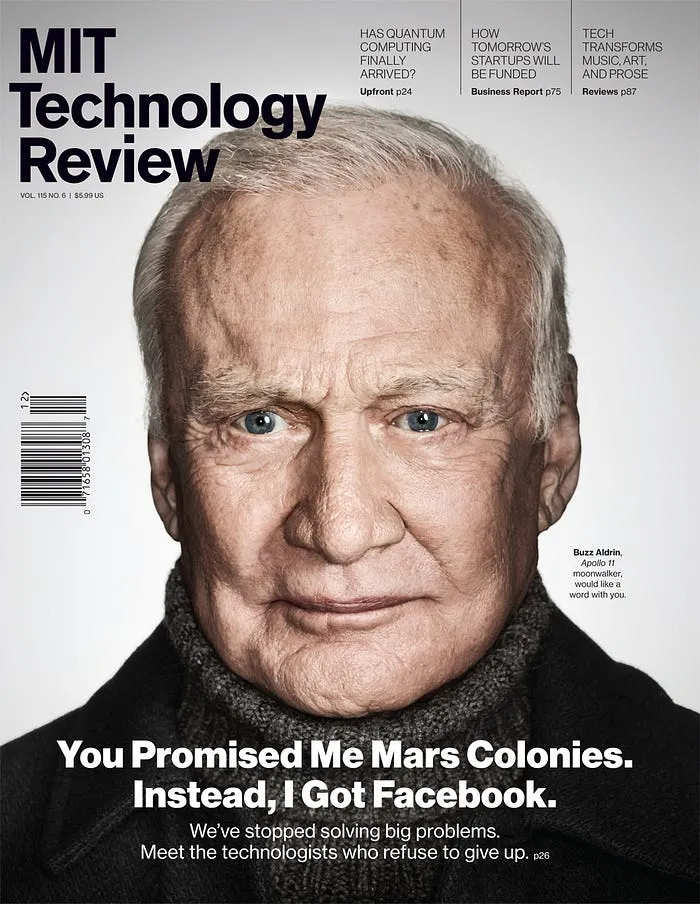 Buzz Aldrin is right
There’s plenty of room for innovation in medicine, renewable energy, transportation, sustainable construction, poverty reduction, improving education in developing countries, combating violence and corruption, and so many other areas. Why do entrepreneurs insist on launching the next social network or yet another app? The world needs relevant and justifiable solutions.
Facebook redefined the way we create and maintain our relationships. But it also opened up so many communication possibilities that today’s relationships begin, develop, and end at a speed never seen before. We are overexposed — without even going into issues like narcissism and other disorders that have increased significantly in this age of convenience. Today we have a need to reconnect with the simple things in life and slow down in our relationships.
In the end, innovation is a cycle that never ends. I can’t wait for a replacement for Facebook, but I also can’t stand watching so many other attempts evaporate for lack of importance. Thinking this way, the 1,200,000 apps available on the App Store is not a reassuring number, since 70% of that is likely crapware.
The idea I want to share is that it’s not so absurd to try to reinvent the wheel, or to seek solutions to already-solved problems, but it is necessary to find in them a good analogy that is justifiable.
Wouldn’t it be great to see a car commercial for a car that pollutes as much as a carriage?
In this era, everything is ephemeral and without essence. But I would genuinely love to live in a world with less technological irrelevance and more ideas of real importance to society.
Originally published on Medium